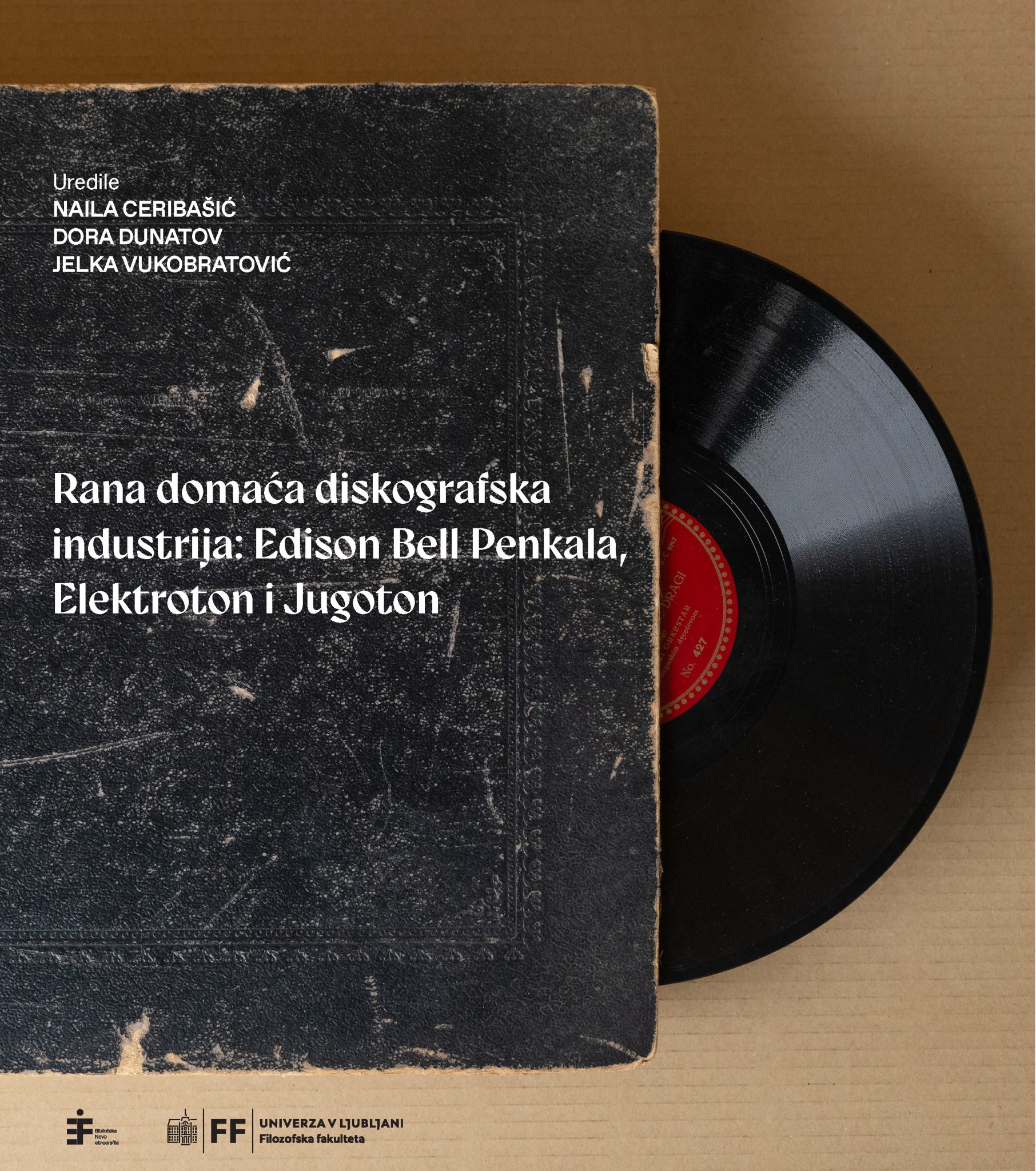
Editors: Naila Ceribašić, Dora Dunatov and Jelka Vukobratović

Publisher: Institute of Ethnology and Folklore Research; University of Ljubljana Press, Faculty of Arts Publishing House

Year of publication: 2025

Price: 45 EUR


PDF

The Early Domestic Record Industry: Edison Bell Penkala, Elektroton and Jugoton

FROM THE REVIEWS

For the studies brought together in this volume, music is no longer necessarily something marked by notation or its absence; for them, music is also something that can be recorded phonographically. In other words, instead of records in the register of the symbolic, this volume considers music that is recordable and recorded in the register of the real. […] If this extensive and multifaceted book offers a kind of history, analysis, and anthropology of domestic musical culture in the twentieth century, it also provides a view of the present, of today’s disputes and problems in dealing with the musical heritage of the previous century.

Dalibor Davidović, Full Professor, Academy of Music, University of Zagreb

The scholarly contribution of this edited volume lies in presenting previously unpublished research results through the well-argued methodological, analytical, and interpretive dimensions of its texts. Since this is a “pioneering undertaking,” the strength of this volume also lies in creating a model, shaping and defining procedures, and identifying key parameters for researching discography.

Lada Duraković, Full Professor, Music Academy, Juraj Dobrila University of Pula

The edited volume is based on exceptionally extensive and excellently systematized material that has not previously been the subject of scholarly study. The authors of the volume proceed from the assumption that such material is important not only to collect, but also to analyze systematically, because it is an extraordinary medium for understanding the production, reception, and distribution of music. A historical perspective on the discographic industries that developed in a specific temporal and spatial context inevitably helps us understand the past of musical life; discography thus becomes a means of reconstructing unknown aspects of musical creativity.

Ana Hofman, Senior Research Associate, Institute of Culture and Memory Studies, Research Centre of the Slovenian Academy of Sciences and Arts

The monograph is the first to systematically examine and compare the development of early discography in the Kingdom of Serbs, Croats and Slovenes and socialist Yugoslavia. On the one hand, it presents reviewed and verified material; on the other, it situates that material within the record production of the period, while also carefully verifying the actual record production of our once shared region, which has not yet been scholarly examined.

Rajko Muršič, Full Professor, Department of Ethnology and Cultural Anthropology, Faculty of Arts, University of Ljubljana

This excellent volume offers a comprehensive study of the Croatian record industry from its beginnings in the 1920s to its flourishing in the 1950s. The authors carefully trace the rise of Zagreb-based record production, the influence of international trends on local music, and other cultural, economic, legal, political, social, and technological developments that shaped the industry during this period.

Dean Vuletic, author and historian, University of Luxembourg